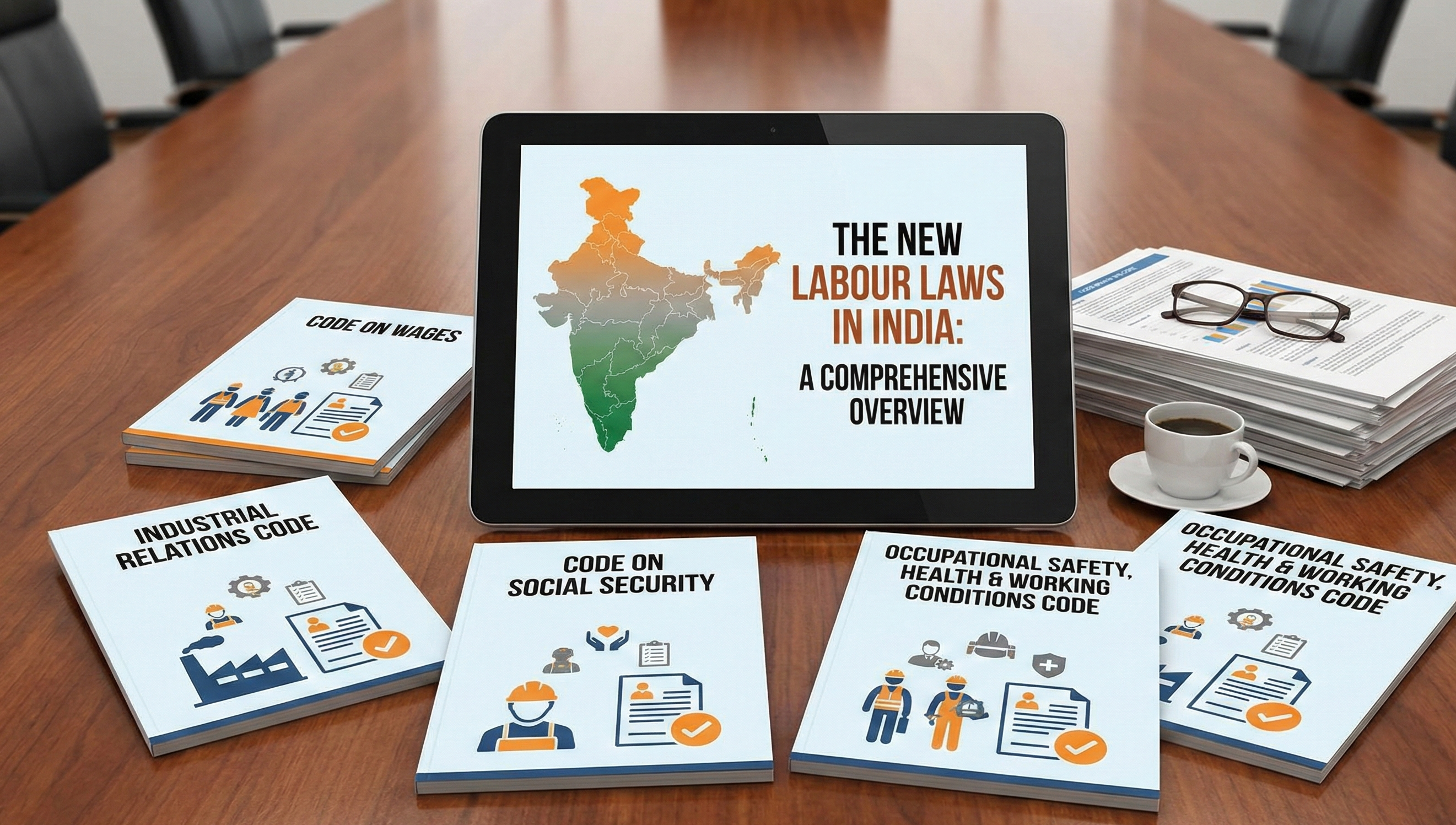
India has introduced a historic overhaul of its labour regulatory framework through four consolidated Labour Codes. These Codes aim to streamline compliance, modernise labour governance, and create a balanced framework for both employers and employees. Although enacted by Parliament, they are yet to be fully enforced nationwide, as final State-level notifications are pending.
This article provides a clear and authoritative overview for HR teams, employers, employees, and legal practitioners.
- The Four New Labour Codes
- Code on Wages, 2019
This Code merges four existing Acts:
- Minimum Wages Act, 1948
- Payment of Wages Act, 1936
- Payment of Bonus Act, 1965
- Equal Remuneration Act, 1976
Key features:
- Standardised definition of “wages” across all laws
- Floor wage to be set by the Central Government
- Mandatory digital/trackable wage payments
- Faster dispute resolution processes
- Industrial Relations Code, 2020
This Code consolidates:
- Industrial Disputes Act, 1947
- Trade Unions Act, 1926
- Industrial Employment (Standing Orders) Act, 1946
Key features:
- Introduction of “Negotiating Union/Negotiating Council”
- Higher thresholds for layoffs, retrenchment, and closure (from 100 to 300 workers)
- Fixed-term employment formally recognised
- Streamlined dispute settlement mechanisms
- Occupational Safety, Health and Working Conditions (OSH) Code, 2020
This Code replaces 13 labour laws related to workplace safety and working conditions, including the Factories Act and Contract Labour Act.
Key features:
- Single registration for establishments
- Mandatory free annual health check-up for workers
- Enhanced provisions for women working night shifts with safety measures
- Standardised norms for working hours, leave, and workplace safety
- Social Security Code, 2020
This Code merges nine laws including the Employees’ Provident Funds & Miscellaneous Provisions Act, Employees’ State Insurance Act, and Maternity Benefit Act.
Key features:
- Wider social security coverage to gig and platform workers
- Digitised and centralised social security registration
- Expansion of ESI coverage to more establishments
- Retention of key maternity benefit provisions (26 weeks leave, etc.)
- Why the New Labour Codes Were Introduced
The primary objectives are:
- To simplify compliance for businesses through a unified legal framework
- To promote ease of doing business and attract investment
- To modernise worker protections to match global standards
- To digitise labour administration
- To eliminate overlapping definitions and contradictory provisions
- Current Status of Implementation
Although the four Labour Codes have been passed by Parliament and assented to by the President, they are not yet fully operational nationwide.
Implementation requires:
- Final Central Government notification
- Parallel notifications by all States
Several States have drafted rules, but nationwide enforcement is still pending.
- What Employers Should Prepare For
Businesses should begin aligning policies in advance. Key areas include:
- Reclassification of salary structures to align with the new definition of “wages”
- Review of leave, working hours, and overtime policies
- Digitisation of compliance and recordkeeping
- Review of contracts for fixed-term and contract labour
- Readiness for unified registration and filings
5. Benefits for Employees
The Codes aim to improve worker welfare by providing:
- Clear entitlement to wages and timely payments
- Improved health and safety standards
- Expanded maternity and social security coverage
- Inclusion of gig and platform workers
- More transparency in employment terms Conclusion
The New Labour Codes mark a transformational shift in India’s labour regulatory environment. While the complete implementation is still awaited, businesses should treat this period as an opportunity to prepare proactively. Once notified, the Codes will fundamentally redefine employer obligations, worker protections, and the overall compliance landscape.