
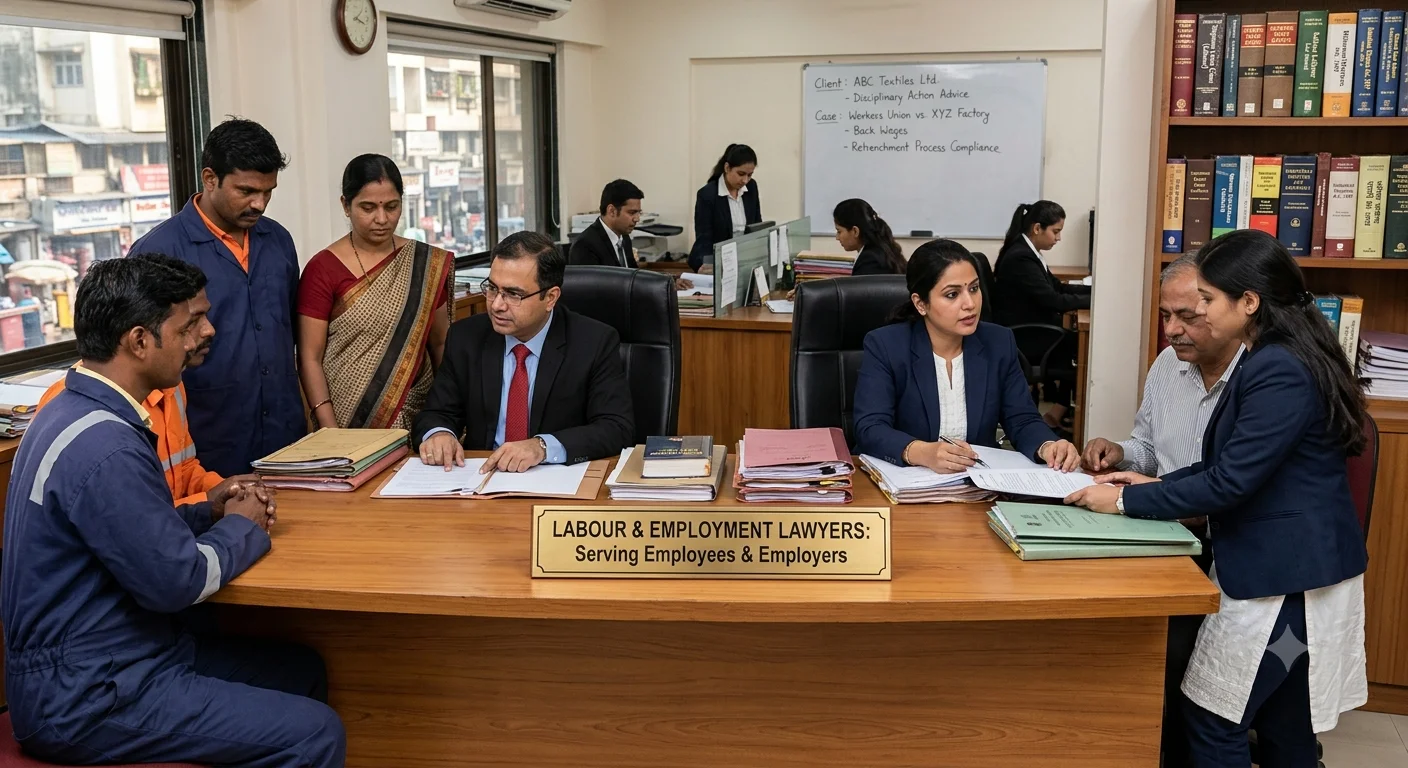
Employment-related problems can affect more than just your monthly salary. A sudden termination, unpaid wages, forced resignation, workplace harassment or disagreement over an employment contract can create financial uncertainty and affect your professional reputation.
In such situations, labour lawyers help individuals and organisations understand their legal rights, obligations and available remedies under applicable Indian employment and labour laws.
Whether you are an employee facing an employment dispute, a senior executive negotiating an exit or an employer dealing with a workplace-related legal issue, obtaining appropriate legal guidance can help you understand your position before taking the next step.
What Do Labour Lawyers Do?
Labour lawyers are legal professionals who advise and represent clients in matters involving employment relationships, labour legislation, workplace disputes and statutory employment obligations.
Their work may involve advising employees, workers, employers and organisations on legal issues arising during recruitment, employment, workplace management and separation.
Depending on the matter, labour lawyers may assist with:
- Wrongful or illegal termination.
- Unpaid salary and delayed full and final settlement.
- Forced resignation and employment separation disputes.
- Notice-period and severance disagreements.
- Employment contract review and interpretation.
- Workplace harassment and discrimination.
- Maternity-related employment disputes.
- Gratuity, provident fund and other employment benefits.
- Disciplinary proceedings and domestic enquiries.
- Retrenchment, redundancy and restructuring disputes.
- Labour law compliance and employer obligations.
The appropriate legal remedy depends on the employee’s role, the nature of the dispute, the applicable legislation and the available evidence.
When Should You Consult a Labour Lawyer in India?
You do not necessarily need to wait until a dispute reaches a court or labour authority before seeking legal advice. Early legal guidance may help you understand your rights, preserve relevant evidence and avoid decisions that could affect your position.
Consider consulting a labour lawyer in the following situations.
1. Wrongful or Illegal Termination
If your employer terminates your employment without following applicable contractual or statutory requirements, you may need to understand whether the decision can be challenged.
A lawyer can review your appointment letter, termination communication, employment status and relevant records to assess the available legal options.
For example, an employee may receive an immediate termination email without a clear explanation, notice pay or settlement of outstanding dues. The legal position will depend on the applicable employment terms and law.
Read more: Illegal Termination Lawyer in India.
2. Forced Resignation by an Employer
Some employees are asked to resign instead of receiving a formal termination letter. HR may suggest that resignation is better for their future career or threaten termination if they refuse.
If you are being pressured to resign, do not make an immediate decision without understanding the consequences.
A labour lawyer can review the circumstances, examine relevant communications and advise whether the resignation process raises legal concerns.
Read more: Can an Employer Force an Employee to Resign in India?.
3. Unpaid Salary and Full and Final Settlement Disputes
Delayed salary, unpaid incentives, notice pay disputes and pending full and final settlements are common sources of employment-related conflict.
Legal assistance may help determine:
- What salary remains unpaid.
- Whether notice pay is contractually or legally payable.
- Whether earned incentives or bonuses remain outstanding.
- Whether leave encashment or gratuity is payable.
- What steps may be available if the employer does not release the dues.
The applicable payment requirements can depend on the type of employment separation and the relevant statutory provisions.
4. Employment Contract and Notice Period Disputes
Employment contracts often contain important provisions relating to notice periods, termination, confidentiality, non-solicitation, intellectual property and compensation.
Disputes may arise when an employer demands notice-period recovery, refuses to pay contractual notice compensation or interprets an employment clause differently from the employee.
A labour lawyer can examine the agreement and explain the possible legal implications before you accept the employer’s demand or sign an exit document.
5. Workplace Harassment and Discrimination
Employees may face inappropriate workplace conduct, discrimination, retaliation or harassment.
These matters may involve internal complaints, disciplinary proceedings, statutory protections and other legal remedies.
Where a complaint involves sexual harassment at the workplace, the applicable framework under the POSH law should also be considered.
Legal advice can help an employee understand the appropriate complaint procedure, documentation requirements and available remedies.
6. Maternity-Related Employment Disputes
Working women may face difficulties involving maternity benefits, termination, changes in responsibilities or pressure to leave employment during or after maternity leave.
The Code on Social Security, 2020 contains maternity benefit provisions, including protections concerning dismissal in specified circumstances.
A lawyer can assess whether the employer’s actions raise concerns under the applicable maternity protections and employment terms.
7. Redundancy, Retrenchment and Organisational Restructuring
Business restructuring, role elimination and workforce reduction can create disputes concerning notice, compensation, selection procedures and employment documentation.
The legal requirements may differ depending on whether the employee falls within the statutory definition of a worker, the nature of the establishment and the applicable provisions.
Before accepting a restructuring-related separation offer, it is important to understand the terms and any applicable entitlements.
8. Performance Improvement Plan (PIP) and Disciplinary Proceedings
An employee may be placed on a Performance Improvement Plan, issued a show-cause notice or asked to respond to allegations of misconduct.
A PIP or disciplinary process should be examined in the context of the employment contract, company policies, applicable legal requirements and the evidence supporting the allegations.
Legal guidance may help you prepare a response, review procedural concerns and understand the potential consequences of the process.
Read more: PIP Lawyer in India.
What Employment and Labour Laws Apply in India?
India’s employment and labour framework includes legislation dealing with wages, industrial relations, social security and workplace safety.
The four Labour Codes are:
- Code on Wages, 2019: Deals with wage-related matters, including minimum wages, payment of wages and related provisions.
- Industrial Relations Code, 2020: Addresses industrial relations, trade unions, standing orders and the resolution of industrial disputes.
- Code on Social Security, 2020: Covers social security matters, including provident fund, gratuity, maternity benefits and other statutory benefits.
- Occupational Safety, Health and Working Conditions Code, 2020: Addresses workplace health, safety and working conditions.
The Government of India announced that the four Labour Codes became effective from 21 November 2025. Their application must be considered alongside the relevant rules, notifications and transitional provisions.
The legal position may also depend on state-specific requirements, the employee’s classification and the nature of the establishment.
Who Can Approach a Labour Lawyer?
Labour and employment legal issues are not limited to factory workers or employees in industrial establishments. Different categories of professionals may require legal guidance depending on their employment relationship and the nature of the dispute.
Employees and Workers
Employees and workers may seek advice concerning unpaid wages, termination, statutory benefits, workplace conditions and employment disputes.
Senior Executives and Corporate Professionals
CXOs, directors, vice presidents, general managers and senior professionals may require advice involving complex employment contracts, severance negotiations, variable compensation, ESOPs, forced resignation and executive exits.
Employers and Businesses
Employers may need legal guidance on employment contracts, workplace policies, statutory compliance, disciplinary proceedings, employee disputes and separation procedures.
Important: Not every employee is covered by the same labour-law remedies. For example, certain industrial dispute remedies depend on whether the individual falls within the applicable statutory definition of a worker. Managerial and administrative employees may need to consider different contractual, statutory or civil remedies.
How Can Labour Lawyers Help Resolve Employment Disputes?
The appropriate approach depends on the nature of the dispute and the client’s objectives. Legal assistance may involve several stages.
1. Understanding the Employment Dispute
The lawyer reviews the facts, employment history, relevant communications and the issue raised by the client.
2. Reviewing Documents and Evidence
Documents may include appointment letters, employment contracts, salary slips, appraisal records, HR emails, termination letters and settlement proposals.
3. Explaining Legal Rights and Available Remedies
The lawyer identifies the relevant legal framework and explains possible options based on the employee’s status and circumstances.
4. Negotiation and Legal Representation
Where appropriate, the lawyer may assist with written representations, settlement discussions, legal notices or proceedings before the competent authority or forum.
5. Follow-Up and Resolution
The matter may be resolved through negotiation, mediation, settlement or formal legal proceedings, depending on the circumstances.
How to Choose the Right Labour Lawyer in India
Choosing a lawyer should involve more than looking at search rankings or general claims of experience.
Before appointing a labour lawyer, consider:
- Relevant experience: Does the lawyer handle the specific employment issue you are facing?
- Understanding of employment law: Can they explain the applicable legal provisions and how they relate to your employment status?
- Document review: Are they willing to examine your contract, HR correspondence and supporting records?
- Practical strategy: Can they explain possible negotiation and legal routes?
- Communication: Are the available options, risks and professional fees explained clearly?
- Confidentiality: Is your employment information handled appropriately?
A lawyer who regularly handles employment disputes may be better positioned to identify issues that are specific to your situation.
Why Consult Divine Lawyers for Employment and Labour Law Matters?
Divine Lawyers provides legal assistance in employment and labour law matters, including disputes involving employees, senior professionals and organisations.
Depending on the nature of the matter, assistance may include:
- Wrongful and illegal termination disputes.
- Forced resignation and employment separation.
- Unpaid salary and full and final settlement.
- Executive exit and severance negotiations.
- Employment contract review.
- Workplace harassment and maternity-related disputes.
- PIP and disciplinary proceedings.
- Redundancy and retrenchment-related issues.
- Employment-related legal notices and dispute resolution.
The legal approach is based on the facts, documents, applicable law and the client’s objectives.
For senior executives and corporate professionals, explore our Executive Employment Lawyer in India services.
For disputes involving termination, separation terms or workplace-related disagreements, you can also explore our Corporate Employment Dispute Lawyer in India page.
Frequently Asked Questions About Labour Lawyers
1. What does a labour lawyer do in India?
A labour lawyer advises and represents employees, workers and employers in matters involving employment rights, wages, termination, workplace disputes, statutory benefits, industrial relations and labour law compliance.
2. When should I hire a labour lawyer?
You may consult a labour lawyer if you face wrongful termination, forced resignation, unpaid salary, notice-period disputes, workplace harassment, maternity-related employment issues or a disagreement involving your employment contract.
3. Can a labour lawyer help with wrongful termination?
Yes. A lawyer can review the termination decision, employment contract, relevant communications and applicable legal provisions to assess whether the termination may be challenged and what remedies may be available.
4. Can I consult a labour lawyer for unpaid salary?
Yes. A lawyer can help examine unpaid salary, outstanding benefits, notice pay and full and final settlement disputes, and advise on the appropriate legal steps.
5. Are labour lawyers and employment lawyers the same?
The terms overlap, but their areas of focus can differ. Labour lawyers often deal with statutory labour protections, industrial relations and worker-related disputes. Employment lawyers may also advise on individual employment contracts, executive exits, severance negotiations and corporate employment disputes.
6. Can a senior executive approach a labour lawyer?
Yes. Senior executives may seek legal advice regarding employment contracts, termination, severance, bonus disputes, ESOPs, forced resignation, confidentiality obligations and exit negotiations. The appropriate legal remedy depends on their employment status and applicable law.
7. Can labour lawyers send a legal notice to an employer?
A lawyer may prepare and send a legal notice where appropriate, such as in a dispute involving unpaid dues, contractual breaches or other employment-related issues. Whether a notice is the right first step depends on the facts and available remedies.
8. Do labour lawyers handle cases outside their city?
Legal assistance may be available across different locations, subject to the lawyer’s practice, professional arrangements, jurisdiction and requirements of the relevant forum. Ask the law firm about its arrangements for your location.
9. What documents should I bring when consulting a labour lawyer?
Useful documents may include your appointment letter, employment contract, salary slips, HR emails, performance reviews, termination or resignation communications, settlement documents and records of unpaid dues. Share only documents you are legally entitled to disclose.
10. How much do labour lawyers charge in India?
Legal fees vary depending on the lawyer, location, complexity of the dispute, document review required and whether the matter involves negotiation, a legal notice or formal proceedings. Discuss the fee structure before appointing a lawyer.
Need Legal Guidance for an Employment Dispute?
An employment dispute can affect your salary, professional reputation, future career and financial security. Understanding your legal position before signing documents, resigning or accepting an employer’s proposal can help you make an informed decision.
If you are facing wrongful termination, forced resignation, unpaid salary, a severance dispute or another employment-related issue, you may seek legal guidance from Divine Lawyers.
For information about employment and labour law services, visit Divine Lawyers or contact the legal team to discuss your circumstances.
Need Legal Guidance for an Employment Dispute?
Facing wrongful termination, forced resignation, unpaid salary, a severance dispute or another employment-related issue? Get clarity on your legal rights and available options before making an important employment decision.
Divine Lawyers
Delhi NCR | Bangalore | Matters across India
Phone: +91 8076287219
Email: deepeeka@divinelawyers.com
This article is for general informational purposes only and does not constitute legal advice. The applicable law and available remedies depend on the facts, employment status, relevant documents and jurisdiction.